

SLL14: What the fuck! 我靠 !!
A dialogue and reflection on the cultures of swearing in English and (Taiwanese) Chinese

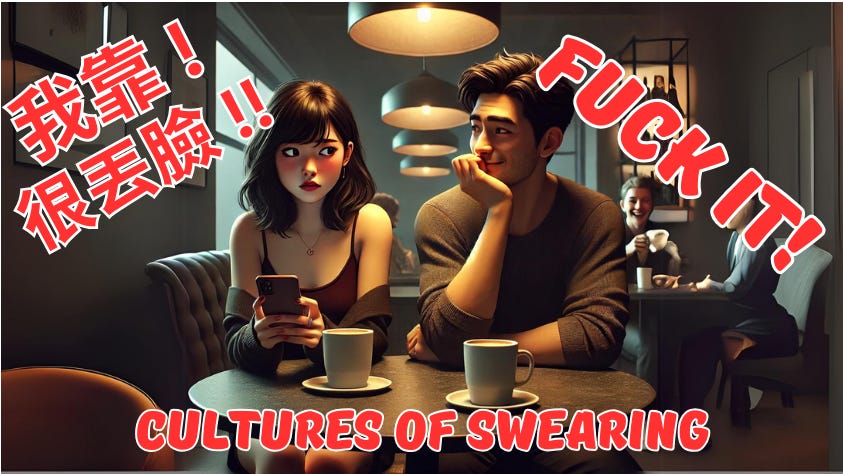
Mei-ling tuned out of the quiet hum of conversations in the café and slowly inhaled the warm, earthy aroma of freshly brewed coffee. She was about to reach for her latte on the matt back table, but her phone pinged.
A message from her boss.
"… Tā mā de (他媽的)", she muttered.
She quickly lowered her voice and whispered, "Duìbùqǐ (對不起)," looking down. Her eyes darted around to see if anyone had heard.
Jake looked up from his novel, eyebrows raised. "What’s wrong?"
Mei sighed.
In a whisper, she blurted, "My boss asked me to do a client presentation for tomorrow. Wáng bā dàn (王八蛋).” She couldn’t contain herself. Or her flushing cheeks.
"Bastard. Tomorrow’s your day off—we have plans! Your boss is a dick!” Jake’s voice grew louder.
The couple at the next table turned their heads. Mei-ling’s cheeks turned a darker shade of red.
“Shhh! Not so loud,” Mei-ling quipped. “You’re embarrassing me.”
“How is this my fault?” Jake asked, incredulously. “It’s your boss who’s the asshole.”
"Shhh,” she hissed more loudly this time, her embarrassment turning into anger. “This is hěn diūliǎn (很丟臉)… I am losing face," she glared.
"Fuck it and fuck him!" Jake exclaimed. "And what the fuck, Mei-ling. Why do you care about what these strangers think of you? Fuck them!" He waved his hand dismissively and took a sip of his Americano coffee.
"We don’t swear in public. It’s serious. It’s shameful."
“I do,” Jake chuckled lightly.
“But we don’t!” Mei-ling chided.
"For Christ’s sake, Mei! They’re not your family! They’re just damned strangers in a cafe!"
“Wo kao (我靠) … You’ve lived here for several years, and you still don’t get it,” Mei-ling said with frustration.
我靠 !! What the fuck!
美玲屏蔽了咖啡廳裡輕聲細語的背景噪音,緩緩吸入新鮮現煮咖啡的溫暖泥土香氣。她正要伸手去拿放在霧黑桌上的拿鐵,手機突然響了起來。 是一則來自老闆的訊息。 「他媽的!」她忍不住低聲咒罵。 她迅速壓低聲音,小聲說:「對不起。」 她低著頭,眼睛四處掃視,看看有沒有人聽到。
傑克從小說中抬頭,眉毛一揚。「怎麼了?」
美玲靜嘆了口氣。 她小聲嘟囔:「我老闆叫我明天給客戶做個簡報。王八蛋!」她再也忍不住了,臉頰也紅了起來。 「BASTARD!明天是你放假的日子,我們有約!你老闆是個DICK!」傑克的聲音越來越大。
隔壁桌的情侶轉過頭來。美玲靜的臉更紅了。
「噓!別那麼大聲!」美玲斥道。「你丟我臉。」
「這怎麼是我的錯?」傑克不可思議地問。「是你老闆是個 ASSHOLE。」
「噓!」她這次更用力地噓聲,尷尬轉為憤怒。「這很丟臉…我丟臉了。」她瞪著他。
「FUCK IT 管他的!FUCK HIM他媽的!WHAT THE FUCK美玲,你為什麼要在意這些陌生人怎麼看你?FUCK THEM去他的!」他揮了揮手,喝了一口美式咖啡。
「我們不會在公共場合說髒話。這很嚴重,很丟臉。」
「我會。」傑克輕輕地笑著。
「但我們不會!」美靜責備道。
「拜託,FOR CHRIST’S SAKE美玲!他們又不是你家人!DAMN IT! 他們只是咖啡廳裡的一群陌生人!」
「我靠…你住了幾年,還是不懂。」美玲沮喪地說。
Epilogue 後記
How people in a culture swear and use profanities tells us a lot about the culture. In the above scenario, Mei-ling as a Taiwanese feels bad about swearing in public and disturbing others, but Jake, as a North American Anglo, rails against this idea, indulging in swearing. He feels it’s a legitimate form of free speech and personal expression. For many Chinese like Mei-ling, using profanities in public is shameful and emotional suppression is the key to protecting face (hù miànzi (護面子), or at least not losing face (diūliǎn 丟臉). This is why Mei-ling felt embarrassed after she let her emotions get the better of her when she blurted tā mā de (他媽的) and wáng bā dàn (王八蛋). Jake, on the other hand, felt no such qualms when he exclaimed "Fuck it!", showing complete disregard for those damned strangers around them.
一個文化中的人們如何罵髒話,能透露許多關於這個文化的信息。在上述情境中,身為台灣人的美玲對於在公共場合罵髒話而打擾他人感到不安,但身為北美盎格魯人的傑克卻對此嗤之以鼻,甚至樂於飆髒話。他認為這是言論自由和個人表達的一種合法形式。
對許多像美玲這樣的華人文化來說,在公共場合罵髒話是一種恥辱,壓抑情緒是維護面子(protect face)或至少不丟臉(lose face)的關鍵。這就是為什麼美玲在情緒失控,脫口而出「他媽的」和「王八蛋」後感到尷尬。另一方面,傑克在喊出「該死!」fuck it! 時,絲毫沒有顧慮到周圍那些該死的陌生人 damned strangers,顯得毫不在乎。
The themes of Mei-ling’s and Jake’s profanities also point to interesting cultural differences.
美玲和傑克的髒話主題也凸顯了有趣的文化差異。
In English, profanities often reference taboo subjects such as body parts, functions, and crude sex acts—terms like "dick," "asshole," “shit”, and "fuck" are direct and explicit. Probably, the most powerful taboo swear word in English language is “fuck”, and Jake’s multiple use of it shows its versatility in grammar (verb and noun), implication and meaning: the verb crudely dismisses something someone, and as a noun in “What the fuck?” or WTF in internet slang, it shows shock and disbelief. Christianity is also another theme in Anglo, and more generally Western, profanities. Phrases like "damned" and "for Christ's sake" are serious religious words and concepts and that are not used lightly by devout Christians, which was the norm hundreds of years ago in England when the English language and culture were evolving. So, using Christian terms outside of the Christian context to express strong emotion is disrespectful and transgressive in traditional Anglo-Western religious sensibility. This why there so many indirectly religious English expletives pepper English speech, like Darn (damn), Heck (Hell), Geez (Jesus), and My goodness! (My God!), to name but a few.
在英語中,髒話常常涉及禁忌的話題,如身體部位、功能和粗俗的性行為。詞彙如dick「雞巴」、asshole「屁眼」、shit「屎」和 fuck「幹或操」直接而露骨。或許,英語中最強力的禁忌髒話是「fuck」,傑克多次使用它,顯示了它的文法多樣性(動詞和名詞)、暗示和意義:動詞粗魯地貶低某人或某事,而名詞 what the fuck「我靠」或網路俚語中的 WTF則表示震驚和不相信。
基督教也是盎格魯文化,更廣泛地說是西方文化,髒話中的另一個主題。短語如「damned」和「for christ’s sake 」(字面意思是為「基督的緣故」,更自然的表達是「天啊」)。
這些片語是嚴肅的宗教詞彙和概念,虔誠的基督徒不會輕易使用這些詞語,這在數百年前英語語言和文化發展時期的英格蘭是常態。因此,在非基督教的語境中使用基督教術語來表達強烈的情緒,在傳統的盎格魯-西方宗教情感中是無禮和越界的。
這就是為什麼英語中有這麼多間接的宗教咒罵語,如Darn(damn)、Heck(Hell)、Geez(Jesus)和 My goodness!(My God!),僅舉幾例。
In Chinese swearing, family honor and reputation are often implied. For example, wáng bā dàn (王八蛋) suggests that the mother had loose morals and the father is unknown (the English equivalent of “bastard”) and tā mā de (他媽的) also refers to mother, literally, “his mother’s”.
Crude descriptions of sex in Chinese, as in English, is also a theme. Wǒ kào (我靠) is an expletive often used to denote shock, and literally means “I lean on” but is a phonetic replacement for wǒ cào (literally “I fuck” but more generally meaning “fuck” or “what the fuck”), like “What the heck?” is an indirect version of “What the Hell?”. So, perhaps the most vulgar profanity combines both family and sex: gàn nǐ niáng (幹你娘) or cào nǐ mā (操你媽) both literally mean “fuck your mother.” Although Taiwan is an advanced democracy, it is still strongly Chinese in “face” culture and law enforcement, so public insults can be legal offenses according to both criminal and civil codes of law. This means that cursing someone in public, especially using the English “Fuck you!!” or even flipping the middle finger, can threaten someone’s public face and result in litigation and fines. Article 310 in the criminal code, for example, states that a person who publicly insults another may be sentenced to detention for up to six months, a fine of up to NT$30,000, or both.
在中文的髒話中,家庭榮譽和聲譽經常被暗示。例如,「王八蛋」暗示母親道德敗壞,父親不明(英語中的「bastard」)。「他媽的」也指母親,字面意思是「他的母親的」。中文中對性的粗俗描述,與英語一樣,也是一個主題。「我靠」是一個常用來表示震驚的粗口,字面意思是「我靠」,但它是「我操」(字面意思是「我操」,但更廣泛地意味著「操」或「我靠」)的音韻替代,就像「What the heck?」是「What the Hell?」的間接版本。因此,或許最粗俗的髒話結合了家庭和性:淦「幹你娘」或「操你媽」,兩者字面意思均為「fuck your mother」。雖然台灣是一個先進的民主國家,但仍然受到中國文化「面子」和執法方面的影響,因此公共侮辱根據刑事和民事法律都可能構成法律犯罪。這意味著在公共場合罵人,尤其是用英語「Fuck you!!」甚至豎中指,都可能威脅到他人的公共面子,並可能導致訴訟和罰款。例如,刑法第310條規定,公開侮辱他人者,可處六個月以下有期徒刑、拘役或新台幣30,000元以下罰金,或併科。
These differences show how cultural values shape language use. Chinese profanity rooted in familial respect and social harmony, while English profanity draws on the taboos of body, sex, and Christianity. Chinese profanity is often a threat to public face, while Anglo profanity is accepted as more a form of individual expression and emotional release.
這些差異顯示了文化價值如何塑造語言的使用。華人文化的的髒話根植於家庭尊重和社會和諧,而英語的髒話則源自身體、性與基督教的禁忌。中國的髒話常常威脅到公共面子,而盎格魯人的髒話則被視為一種個人表達和情緒釋放的形式。
這些差異說明了文化價值如何塑造語言的使用。中國的髒話植根於家庭尊重和社會和諧,而英語的髒話則源於身體、性、和基督教的禁忌,但最終被更多地接受為一種個人表達和情緒釋放的形式。
Vocabulary
Common English Swear Words (with Chinese meanings)
Fuck, 幹(gàn) , 操 (cāo)
Fuck off, Lit.: 操你 (cāo nǐ) - fuck you / Equiv.: 去死 (qù sǐ)
Shit, 屎 (shǐ)
Piss, 小便 (xiǎobiàn)
Piss off , 滾 (gǔn) or 滾開 (gǔn kāi)
Dick / cock , 屌 diǎo , 雞巴 (jībā), 小雞雞 xiǎo jī jī
Cock sucker , Lit.: 吸屌 xī diǎo / 吮屌 shǔn diǎo
Prick / Cock / Dick , Lit.: 雞巴 (jībā); Equiv.: 小混蛋 xiǎo húndàn
Cunt, Lit.: 屄 (bī); Equiv.: 婊子 biǎozi
Ass, Lit.: 屁股 (pì gu)
Asshole, Lit.: 屁眼 (pì yǎn)
Bitch, Lit.: 母狗 mǔ gǒu , 婊子 (biǎo zi) , 賤人 (jiàn rén)
Bastard, Lit.: 私生子 sīshēngzǐ , Equiv.: 王八蛋 (wáng bā dàn)
Mother fucker (Fuck your mother) , 操你媽(cào nǐ mā) , 幹你娘(gàn nǐ niáng)
Damn, 靠北 (kào běi)
Hell, Lit.: 地狱 (Dì yù)
Common Taiwanese Mandarin Swear Words (with English translations)
靠北 (kào běi) / 我靠 (wǒ kào) , "damn" , "shit" “What the fuck”
死囝仔 (sǐ jiǎn zǎi) , Lit.: "dead kid", Equiv.: dick, prick
白目 (bái mù) , Lit.: "white eye” – idiot
神經病 (shénjīngbìng) , crazy, insane
三小 (sān xiǎo) , Lit.: from Taiwanese "什麼小" (What the small), Equiv.: "What the hell?"
王八蛋 (wáng bā dàn) , "bastard" , "son of a bitch."
幹你娘 (gàn nǐ niáng) , “do” your mother
操你媽 (cào nǐ mā) , “fuck your mother”
婊子 (biǎo zi) 賤人 (Jiàn rén) , "prostitute", "cheap person" or "bitch"
